By Heather Cecilia Phanwar for Smart Village Movement

By Heather Cecilia Phanwar for Smart Village Movement
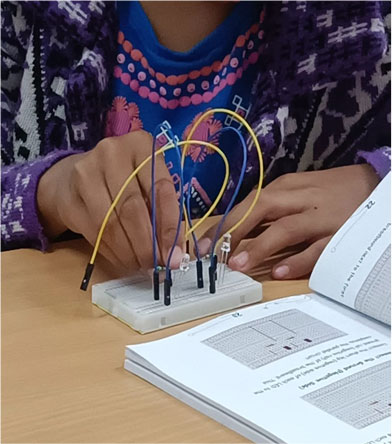
A class VI student experimenting with a breadboard circuit at the NECTAR lab in Shillong.
In today’s world, opportunities are plentiful for children. With numerous choices available, they are able to get the proper guidance of what they are passionate about from a young age. From school to extra-curricular activities, they are getting the opportunity to choose and enhance their skills that interest them. Keeping in mind the gap of the education system, especially in rural areas, Smart Village Movement (SVM) aims to bridge the digital and educational divide by empowering students to excel in today’s world.
To improve access to quality science and mathematics education for rural students with limited opportunities, SVM introduced STEM (Science, Technology, Engineering, and Mathematics) programs in underserved areas. This type of education allows children to learn things practically rather than just theoretically. It goes beyond textbooks and traditional classroom learning. It can be termed as a ‘hub of creative learning’ where students are engaged in hands-on experiences and gather knowledge that they can apply to real-life situations and contribute to the development of rural communities. Through such initiatives, even students who previously lacked the opportunity or resources to engage in innovative learning are now able to access and benefit from STEM education.
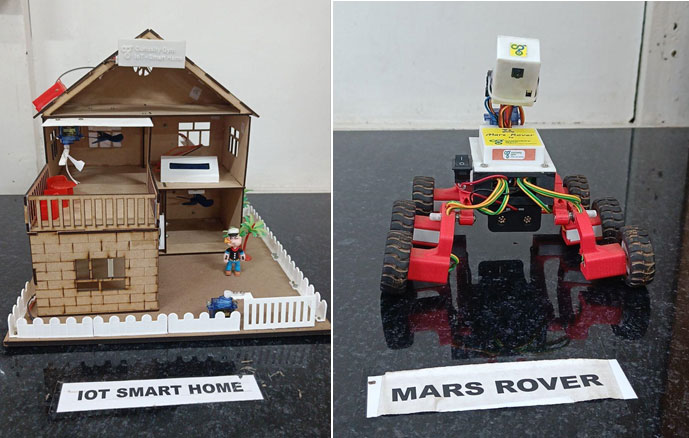
Through STEM, students are actively involved in the learning process rather than just becoming passive learners. This engagement helps them understand the subject matter better. It also helps them gain insights, develop their skills and passions, and showcase their creativity through different projects and activities. The STEM activities include robotics, engineering, coding, electronics, 3D designing, architecture, interior design, mathematics and science.
While Smart Village Movement is actively working to bridge the gap in education in rural areas, the successful implementation of the STEM education model at two schools— Myngken Christian Higher Secondary School at Ri Bhoi district and MDC Multipurpose Higher Secondary School, Mawngap are prime examples of SVM’s mission of empowering villages through accessible education and technology. The students in these two schools were engaged in different projects and activities to showcase their skills. Teachers were given training and tools on STEM activities so that they would be able to incorporate it into their curriculum. As this initiative took off to new heights, a STEM lab was inaugurated at the North East Center for Technology Application and Reach (NECTAR), Shillong. This lab has a STEM trainer who helps the students perform their activities based on what they want to learn. The trainer guides them if they need any help and lets them experiment to their full potential. Feedback is given to the students so that they can improve and perform better. STEM mobilisers are also there to look after the welfare of the students.
The lab is open for students from Class V to Class X. Mondays, Wednesdays, and Fridays are for older students, while Tuesdays and Thursdays are for the younger ones. It is also open to students below Class V to observe and perform the DIY activities available at the lab. In an interaction with the trainer, he explained that this lab has opened opportunities for children who have a passion for science and technology. This allows them to showcase their potential and passion at an early age. Being able to do it more practically helps them navigate the activities easily. The STEM mobilisers keep track of the everyday activities of the lab as well as interact with the students. They also visit different schools in the city to promote the introduction of STEM into the school curriculum.
While observing students in the lab, a Class VI student was experimenting with a breadboard circuit. As she was working, she happily shared, “I enjoy coming to the lab even after school. I am not tired and I love it.” After navigating through the circuit with the wires to see the result, the LED light lit up and she was smiling gleefully. With a satisfying look on her face, she informed the trainer that the activity was done. At a young age, she is able to navigate the breadboard by following the instructions from the curriculum book. When asked about her future, she confidently replied, “An IPS officer,” a smile lighting up her face.
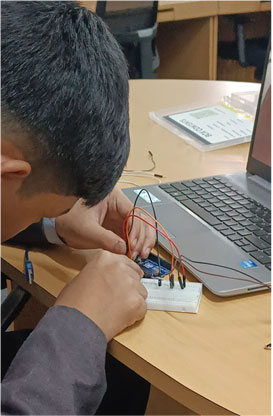
A student connects wires to a breadboard and the Arduino UNO microcontroller and a laptop to program and control the output of the LEDs.
Aligned with Smart Village Movement’s mission to build smart villages and empower communities through digital technology, this initiative serves as a powerful catalyst for rural development. The implementation of STEM education programs in Meghalaya clearly shows how effective it is at bringing about change. The establishment of STEM labs marks a pivotal moment for education in rural areas, offering students the chance to explore their potential and compete on equal footing with their urban counterparts. Positive feedback from students reflects how the hands-on activities in these labs spark creativity and curiosity, nurturing not only their skills but also their hopes for a brighter future.